Monday, 20 June 2011

SlutWalk Edinburgh

All photographs courtesy of David Lesault http://cowidget.demotix.com/users/lesault/profile

White Ribbon Campaign UK adds it support for Edinburgh SlutWalk - 'Whatever we wear, wherever we go, Yes means Yes and NO means NO' - and rape is rape.

200 peaceful protesters marched down Edinburgh's Royal Mile to the Scottish Parliament to raise awareness of attitudes to rape and sexual assault. Edinburgh, Scotland. 18th June 2011

Protestors pose for photographs in West Parliament Square at the start of the Edinburgh SlutWalk.

200 peaceful protesters marched down Edinburgh's Royal Mile to the Scottish Parliament to raise awareness of attitudes to rape and sexual assault. Edinburgh, Scotland. 18th June 2011

At 2pm on Saturday 18th June, the SlutWalk movement arrived in Edinburgh to raise awareness of attitudes to rape and sexual assault.

A group of around 200 people marched from West Parliament Square down the Royal Mile to the Scottish Parliament buildings at Holyrood. The aim of the march was to raise awareness of attitudes to rape and sexual assault, specifically that what a person wears does not give a rapist an excuse to attack them.

Protestors began gathering outside St Giles Cathederal around 1:30pm and the march began at 2pm. Many of the participants were wearing stockings, suspenders, corsets and mini-skirts and chanted "However we dress, wherever we go, yes means yes and no means no." People held placards with messages such as "It's a skirt, not permission", "My dress was not a yes" and "No means no whatever you're wearing". Many of the placards called for the sacking of Kenneth Clarke after his recent comments on the seriousness of rape.

There was a fairly large police presence with police motorcycles clearing the road in front of the march but the protest was good natured and passed peacefully.

There were some short talks from support groups, the SlutWalk organisers and rape survivors outside the Scottish Parliament building.

Thursday, 9 September 2010

INTERNATIONAL: Violence against women: an international epidemic

These are extracts from an article written by Gerald Caplan, published in Canada, the original home of the White Ribbon Campaign.

Twelve girls and women have been murdered by family members in Canada since 2002; these grisly deaths, perversely known as honour killings, have all taken place in certain minority communities. But these minorities have no monopoly on such savage brutality. In Ontario alone between 2002 and 2007, 202 women were murdered by their partners, an astonishing average of 42 each year.

About 20 years ago I was part of a small group of men who founded the White Ribbon Campaign – men working to end violence against women. It was one of the best things I've ever done. The campaign continues to operate both in Canada and many other countries, doing its best to make men aware that any kind of physical violence against women is completely unacceptable, full stop. There are no exceptions. The best-known of the founding members of the White Ribbon Campaign was Jack Layton and he has never tried to exploit his contribution for political gain, a rare example of integrity that I have long admired.

The full article can be found at http://www.theglobeandmail.com/news/politics/violence-against-women-an-international-epidemic/article1657795/

Friday, 21 May 2010

Adriana Running London Office


A warm welcome to Adriana who will now be running the London office. We are sorry to lose Kaitlin but are equally enthusiastic about Adriana taking the helm. Best wishes to her in her new capacity as London co-ordinator for the White Ribbon Campaign

Friday, 23 April 2010

A Fond Farewell

My time with the White Ribbon Campaign UK has come to an end and I am moving on to another human rights organisation. It's been a delight working with the White Ribbon Campaign and I look forward to supporting this campaign in the future. This blog will likely be inactive for a few weeks until my replacement is settled in London.

While you're waiting for the blog to start up again, check out these books and movies relating to male violence against women:

Books

(1) This Charming Man by Marian Keyes - A story of four women and one very "charming" man

(2) A Thousand Splendid Suns by Khaled Hosseini - an amazing story of two women in Afghanistan and how they're lives converge over several decades

(3) The Girl with the Dragon Tattoo by Stieg Larsson - The first of the Millennium series, this gripping thriller was originally titled "Men Who Hate Women." It's a bit slow at the beginning, but takes off about halfway through. The Swedish film adaptation of this book is in theatres now. Though not as good as the book, it is still a decent film. Warning: it is a bit graphic.

(4) The Woman Who Walked into Doors by Roddy Doyle - this infamous novel is about Paula Spencer, abused by her husband. The novel is narrated from her perspective.

Movies

(1) North Country - Based on a true story, this film tells the story of a group of female mine workers who win a landmark sexual harassment case.

(2) Behind the Smile - A short documentary on prostitution and trafficking in the UK, produced by the Anti-Trafficking Alliance. It can be seen here.

(3) The Stoning of Soraya M. - I first saw this at the Toronto Film Festive almost 3 years ago, and it has stayed with me every since. It tells the true story of an Iranian woman who is falsely accused of adultery and is consequently stoned. An amazing film, the climactic stoning scene is very difficult to watch, but extremely important to convey the horror of the act.

(4) There are several other films relating to violence against women. Hollywood films include Precious: Based on the novel "Push" by Sapphire, Sleeping with the Enemy, the Colour Purple, and Enough.

Take care, and continue to never commit, condone, or remain silent about violence against women! And keep checking our new and improved website: www.whiteribboncampaign.co.uk

x Kaitlin Bardswich

Thursday, 22 April 2010

Women in Politics

As the second political party leaders' debate takes place this evening, it's fitting to ask - Where do women's rights fit in? Last month, our friends at Eaves hosted Women's Question Time. The panellists were Vera Baird QC MP (Labour), Theresa May MP (Conservative), Lynne Featherstone MP (Liberal Democrat), and Caroline Lucas MEP (Green). The panel was chaired by Yasmin Alibhai-Brown, columnist for The Independent. This panel gave us a rare look at the women in politics, when the focus is usually on the men - and the male party leaders. Yesterday, an an article appeared in The Guardian on this topic:

Women in a very male general election

Election 2010 sees increased emphasis on party leaders which MPs say is marginalising female political voices


women-labour-MPs

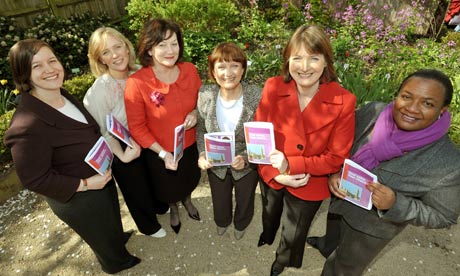
‘A woeful lack of representation’… (Left to right) Labour MPs and parliamentary candidates Meg Hillier, Stella Creasy, Joan Ruddock, Tessa Jowell, Harriet Harman and Diane Abbott. Photograph: John Stillwell/PA/PA

The increasingly presidential style of the UK general election campaign has edged senior women politicians out of the forefront of the political debate, shifting focus instead on to the wives of the three party leaders, a number of prominent female Labour MPs conceded today.

Women in all three main parties have been at the margins of the political campaign, with greater attention paid to the activities and outfits of the leaders' spouses than to the roles played by senior women politicians, in a shift described as a significant regression by campaigners for improved representation of women in parliament.

The shift in focus has been exacerbated by the increasing prominence that the leaders' debates are playing in the campaign, concentrating attention on the three male party leaders rather than a wider spectrum of politicians, and triggering an intensified interest in the supporting role played by their partners.

"As we watch this election, it is clear that women politicians are markedly absent. We have a lot of wives, but not many women MPs," said Kat Banyard, co-founder of UK Feminista and author of The Equality Illusion, a recent study of modern feminism. "All the main players are white men. The lack of female role models is really stark."

Ceri Goddard, chief executive of the Fawcett Society, which campaigns for greater equality between men and women, said: "There is still a woeful lack of senior representation of women in politics and that is reflected in the election campaign."

At an event yesterdaythis morning to celebrate the record number of women standing as Labour candidates, Tessa Jowell, Cabinet Office minister, acknowledged that traditional aspects of the campaign, such as press conferences, had been supplanted by the leaders' debates, shifting more attention to the male leaders, but she stressed that she and other women politicians still "feel at the forefront" of the campaign.

"This is the most activist-led, grassroots-led campaign that I have worked on, largely driven by the internet. Women MPs are all over the country getting votes."

Harriet Harman, deputy leader of the Labour party, said: "Politics has always been male-dominated – that's why we have much more work to do."

"There is a growing celebrity culture in this country," said Joan Ruddock, an undersecretary in the Department of Energy and Climate Change. "It is inevitable that the leaders' families are more prominent than a decade ago. The Obama election has played into that as well."

Defending the party's record, Harman said Labour had attracted many more women into parliament than the other two main parties, with three times more female MPs in the last parliament than all other parties put together – 94 women MPs, compared with 18 for the Conservatives and nine for the Lib Dems. In seats where Labour MPs are retiring, 53% of Labour candidates are women.

Diane Abbott, Labour MP for Hackney North and Stoke Newington, said that, when she first stood as a candidate in 1987, "Many people didn't believe that I could win because the notion of an MP was of a middle-aged white guy in a suit. Things really have moved on. If you raised subjects like work-life balance or childcare 20 years ago, people would say, 'But that's not really politics.' Now the party leaders are all talking about it. Things have progressed – perhaps not as much as I would have liked, but they have progressed."

Jowell argued that the number of policies benefiting women and children during Labour's administration was a reflection of the increased representation of women, citing Sure Start, better childcare facilities and child tax credits.

Campaigners such as Goddard believe the way politicians have tried to appeal to female voters marks a regression.

"There is a focus on women as mothers and only mothers, particularly as the polling is showing that middle-class mothers are a key voting group and all three parties are targeting them. This has had the unfortunate knock-on effect that much of the coverage of women in the campaign has been about women as mothers."

The Conservative party's drive to alter the male-dominated profile of its shadow cabinet has failed, according to a poll published in the Financial Times this week, in which most people questioned could not name a single female Tory MP. Theresa May, shadow work and pensions secretary, is a lone female figure in the Conservative campaign. But party officials point out that a third of its candidates are women, most in winnable seats.

"If the Conservatives have a majority of one we will have 60 female MPs in parliament," May said yesterday. "However, I realise we need to continue the process of getting more women involved in politics."

Banyard is despondent about the proportion of women MPs. "There was massive progress in 1997 when we saw the number of women MPs doubling. But that has ground to a halt and we only have six more women MPs today than we did in 1997," she said. "We have slipped to 73rd place in the world league table for women's representation as MPs."


And if you want to read about Conservative MP Theresa May, who has been a keen supporter of the White Ribbon Campaign UK, check out The Guardian's December article here.

Wednesday, 21 April 2010

Women's Link Worldwide's Gender Justice Uncovered Awards

Women's Link Worldwide is an international human rights non-profit organization working to ensure that gender equality is a reality worldwide. They annually judge the Gender Justice Uncovered Awards, deciding on the best and worst decision made in English or Spanish relating to gender justice. There is also a People's Choice Award based on the public's vote. So make sure you vote by May 10!

Check out the video on the Gender Justice Uncovered Awards:


Across the world, people are uploading videos to explain why they are voting for the Gender Justice Uncovered Awards. Here's a video from Iceland:


And here's a short video I made of my friend Paul Goldsworthy discussing the Awards in Waterloo, Ontario, Canada.


The White Ribbon Campaign UK supports the Gender Justice Awards. Vote by May 10 here.

Tuesday, 20 April 2010

Earthquakes Caused By Promiscuous Women

Today the BBC reported on a story from Iran, where a senior cleric said that promiscuous women are responsible for earthquakes. While most will find this laughable, it is also an example of hate speech that could lead to violence against women if they are viewed as being "promiscuous" and therefore responsible for earthquakes. Let's hope that does not happen.

Iranian cleric blames quakes on promiscuous women

The reuined citadel of Bam aftern the 2003 earthquake
More than 25,000 people died in the Bam quake

Promiscuous women are responsible for earthquakes, a senior Iranian cleric has said.

Hojatoleslam Kazem Sedighi told worshippers in Tehran last Friday that they had to stick to strict codes of modesty to protect themselves.

"Many women who do not dress modestly lead young men astray and spread adultery in society which increases earthquakes," he said.

Tens of thousands of people have died in Iran earthquakes in the last decade.

Mr Sedighi was delivering a sermon on the need for a "general repentance" by Iranians.

"What can we do to avoid being buried under the rubble? There is no other solution but to take refuge in religion and to adapt our lives to Islam's moral codes," he said.

'Disappoint God'

Young Iranians sometimes push the boundaries of how they can dress, showing hair under their headscarves or wearing tight fitting clothes.

Mr Sedighi also referred to violence following last year's elections, which occurred when thousands of - mostly young - Iranians protested against the result, as a "political earthquake".

"Now if a natural earthquake hits Tehran, no one will be able to confront such a calamity but God's power, only God's power. So lets not disappoint God."

More than 25,000 people died when a powerful earthquake hit the ancient town of Bam in 2003.

Seismologists have warned that the Iranian capital Tehran is situated on a large number of tectonic fault lines and could be hit by a devastating quake soon.

President Mahmoud Ahmadinejad has said many of Tehran's 12 million inhabitants should relocate.

There are plans to build a purpose built new capital near Qom.